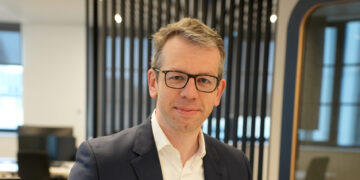
In a recent LinkedIn post, people analytics expert Ralf Büchsenschuss offers a glimpse into his work: through AI agents leaders and managers gain real-time insights into their team across roles, tenure and locations, enabling more informed decision-making. The goal is to strengthen employee experience, foster collaboration and accelerate skill development. “But the real challenge,” he highlights, “remains behavioural change.”
A strong focus on HR, data and technology defines Ralf Büchsenschuss’ role as AI Workforce, Analytics & Transformation Lead at Microsoft. With a strong HR background, with a particular focus on transformation, people analytics and strategic workforce planning, his work sits at the intersection of practice and research: Ralf is also a guest lecturer on people analytics at INSEAD and Mannheim University. “I am part of the AI workforce unit, where it ultimately comes down to bringing AI and employees together to understand AI and to determine its true potential”, he explains.
Security and trust as essential prerequisites
Within the broader HR framework, Ralf does not see his mandate as purely technology-driven. “On the contrary,” he says, “you need to work simultaneously on multiple pillars: rethinking processes, developing culture and building skills. Very often, the challenge is how technology changes the way people work.” A vision that broadly shapes how Copilot is positioned within a Human AI approach. “Security and trust are essential prerequisites. In an enterprise context, you must know where your data goes. With secure technology, intellectual property remains within the organisation and data is not used for external model training. Safe AI is fundamental to building the trust required for change management.”
The real challenges: behaviour, mindset and skills
Data security is a necessary condition, but far from the only challenge in organisation-wide AI adoption. According to Ralf Büchsenschuss, the biggest pitfall lies in behavioural change. “It takes a long time before you actually see it within organisations,” he explains. “AI requires us to work differently: faster, more productive and also creative. That means rethinking processes and even rethinking business processes and bending the curve of innovation. AI is a potential disruptor of entire industries.” Company culture plays a crucial role in this transition. “Being able to experiment without fear of making mistakes is essential, and leadership and HR must actively create that space.”
No augmentation without existing skills
In his HRcoreLab keynote, Ralf will focus on the core question: what does Human-Agent collaboration mean for HR and what role does HR play in organisational transformation? The largest gap between AI’s potential and actual business value, he argues, is not technological but human. “Technology is evolving at an incredible pace. The biggest gap lies in mindset and skills. Human-AI collaboration is about augmenting human capabilities, but if an organisation has a lack of skills to begin with, there is nothing to augment.” This reality demands a different attitude towards AI and skills, from both employees and organisations. “Everyone needs to reflect on their own skill set and continue to invest in learning. Continuous upskilling, resilience and learning agility are no longer nice-to-haves, but prerequisites for making progress in an AI-driven world of work.”
From basic to meaningful adoption
To move from basic AI usage to genuine skill augmentation, technology in itself has its limits. “Organisations need the right partners to guide them through transformation. Vendors should not only deliver tools, but also invest in enterprise-wide skilling, collaborate with schools and universities, and help organisations grow.” Underlying all of this must be responsible AI principles. “Fairness, Reliability & safety, Privacy & security, Transparency, Accountability and Inclusiveness must form the foundation. Only then can blind spots be addressed and better decisions be made based on a broader spectrum of parameters.”
Ralf also sees his own role evolving in ways that illustrate how the organization itself is changing. “Where my work used to focus on prompting, information retrieval and content creation, I now increasingly delegate tasks to agents or even agentic teams. I validate the output in the same way I used to with human teams. Especially in the beginning this makes my work more demanding but also more efficient.” AI is not only transforming how organisations work, but also how work itself is organised, including the roles of those shaping the transformation.
Key takeaways
- AI only creates business value when skills evolve alongside it. Without existing capabilities and learning readiness, there is nothing to augment.
- The biggest AI gap lies in mindset and culture, not in technology. Secure tools are a prerequisite; leadership and room for experimentation accelerate adoption.
- Human-AI collaboration fundamentally reshapes work. HR plays a pivotal role in redesigning work, roles and decision-making in an AI-driven organisation.