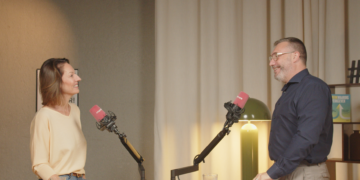
David Garrote Yáñez built much of his career in large multinationals including Lidl Spain, where he established an internationally recognised employer branding approach and led a cultural transformation involving more than 20,000 employees. Today he is the Head of Talent Acquisition, Employer Branding and DE&I at Carglass Spain. The organisational psychologist says out loud what many HR professionals and business leaders think but rarely voice: culture does not change through communication, employer branding is not a LinkedIn campaign, and many behaviours we attribute to character can also be reasonable responses to the system around us.
A resignation in the making
“In a tight labour market shaped by uncertainty, attracting talent with ever-bigger promises is a poor strategy,” says David Garrote. “Over-promising may help you close a hire. It can also set up a future resignation months in advance. Retention therefore begins long before the first working day: in the design of the role, the quality of the manager and the question of whether the organisation will actually put the person to good use. The goal of organisations is not merely to attract valuable people, but to build a place where they can do valuable work without having to fight the system every single day. Broader forces make that more challenging, such as an ageing workforce, a shortage of specific skills and AI.”
No theme park
Employer branding is still too often reduced to a marketing campaign. “You can have an excellent campaign, an attractive employer value proposition (EVP) and a sparkling video. But if you then take two weeks to give feedback, or if the actual job turns out to look nothing like the vacancy, the brand has already been created. It is simply a different brand from the one in the presentation. It is a mistake to treat employer branding as a layer of communication on top of the organisation. Communication amplifies what is already there. So promise only what your organisation and the system can actually demonstrate. If you talk about development, there must be real career paths. If you promise autonomy, employees must be able to take decisions without approval from five levels up. As an organisation you really do not have to pretend to be perfect. People accept that a company is not a theme park. What they do not accept is being sold a story. A credible EVP can openly acknowledge tensions: for example, high expectations come with learning, autonomy is tied to responsibility.”
At Lidl, David Garrote helped build an internationally recognised employer branding approach. What made the difference? “The attractive campaigns and visible elements mattered, of course. But the real difference came from building a machine based on data, processes, governance and a strong candidate experience. One thing I came to value even more was building a team, documenting knowledge and making sure it could be shared. A project proves that someone did something well. A system proves that it no longer needs that person in order to keep growing.”
From intuition to data
Garrote makes the case for a data-driven approach, but he is the last person to bury HR under graphs. “Sometimes the opposite is true: the less clear the objective, the more indicators we add. In talent acquisition we still measure a great deal of activity and not enough of the system. We count interviews and numbers of applicants, but not the response time of managers or the cost of an open vacancy. If people analytics only proves that HR has been busy, we have built an expensive mirror.”
David Garrote is no fan of universal lists of KPIs, yet he does point to five dimensions that are relevant for every HR director. “The productivity of the workforce, the cost of missing capacity, the quality of hiring, the loss of relevant talent, and the build-up of internal capability through mobility and applied learning. You have to translate these dimensions into usable measures. If there’s one HR KPI I’d drop, it is the number of training hours as proof of development. The fact that someone spent eight hours in a room proves nothing. We report that kind of activity too often because it is easy to count. What the business actually needs to know is what resulted from that training.”
Professional instinct
Data tell you where to look; your judgement helps you find an explanation. “But judgement is not improvisation. Professional instinct is built through experience, observation, mistakes and the willingness to discover that you were wrong. Data protects instinct from fantasy, and instinct stops data from becoming a lazy explanation. Qualitative work therefore matters: listen to the people doing the work, ask follow-up questions about the changes, observe the process and compare teams.”
As AI makes intelligence and competent output cheaper, judgement becomes even more valuable. “The opportunities of AI are enormous, but so are the challenges. Automate a badly designed process and you produce mistakes at a remarkable speed. Buying a licence is easy, changing habits and skills is another matter. For me, at least, the interesting question is not how many hours we save, but what we do with them.”
The blueprint
According to David Garrote, organisations get precisely the behaviour they reward. Organisational design sits at the centre of his thinking. It shapes behaviour because it determines who has information, who can act, who carries the risk and what happens afterwards. This is where organisational psychology blends into behavioural engineering.
So how do you actually apply organisational design? “First, define the required behaviour in observable terms. Do not be vague, but answer the question of what someone should do differently on a Monday morning. Then map the current system: look at decision rights, objectives, information flows, capabilities, tools and rewards. Find where the design discourages the desired behaviour. Asking for autonomy while demanding five signatures, for instance, is a refined way to waste time. Next, change a few levers and observe what happens. Remove an approval, say, share information or recognise different behaviour. Finally, simply adjust where needed.
Organisational design is not a grand monument, it is a hypothesis about how a living system will behave. When a behaviour keeps recurring, the problem may not lie with the attitude but with the blueprint.”
Courageous people
At Lidl, David Garrote led a cultural transformation for more than 20,000 employees. His lessons learned? “The first lesson is that culture does not change through communication. It changes through consistent decisions, repeated over time. Every cultural principle has to work for every team and site, not just for the executive committee. A second lesson is that people experience culture through middle management, namely the managers who approve their leave and give them feedback. You can build an appealing story about trust. But if the direct manager punishes mistakes and controls every detail, we know which culture will win. The most challenging lesson is that every important change needs courageous people. Changing the posters is easy. Refusing to promote someone who delivers results but wrecks their team takes courage.”
“You know a culture change is working when someone on the ground can explain, in their own words, what they now do differently and why. If I wanted to observe a culture change apart from the indicators, I would choose a moment when something had gone wrong. I would watch who speaks first, who stays silent, who gets interrupted, and whether a junior employee dares to contradict someone with power. I would also observe a routine meeting: who holds the information, who really decides and what happens to disagreement. Org charts tell a very polite version of power. Meetings are less discreet.”
Organisational productivity
Many HR departments want to be business partners but still too often get stuck in operational tasks. “Being a business partner is not a title. It means understanding how the company makes money, where it loses capacity, what slows productivity, and which organisational risks could derail the strategy. HR also has to let go of the programme as a default answer. When the business asks for training or a hire, HR has to ask which problem it is trying to solve. After that, we have to roll up our sleeves. A business partner designs workable solutions, clarifies responsibilities, measures the effect and stays on board when the boring part begins. A good idea that nobody adopts remains just a good idea.”
David Garrote puts organisational productivity firmly at the top of the agenda. “By that I do not mean asking people to run faster. Rather, we have to work on the architecture that shapes performance. Many companies solve design flaws through human effort. People compensate for an absurd approval, reconstruct information scattered across five systems and turn every exception into a small act of heroism. From the outside it looks like engagement, but sometimes it is simply an organisation paying interests on its own debts. HR should be at the heart of that conversation because we work with the most complex part of the system, namely people. As a CEO, I would want a people function that raises organisational capacity without turning employees’ lives into an obstacle course.”
“I can’t say this in my company, but…”
“In my keynotes I speak honestly about power, incentives, contradictions and unwritten rules. This comes from a simple belief: you cannot transform what you refuse to describe honestly. People often tell me that I put words to something they already knew. They frequently begin with, ‘I can’t say this in my company, but…’. That sentence sums up my work rather well.”
He is equally careful not to romanticise his own career. He comes from a working-class family and was the first in his family to go to university. “I don’t want to turn it into one of those comfortable meritocracy stories. I worked extremely hard and I am proud of the path I have travelled. But fortunately there were also people who trusted me and gave me chances. Luck rarely looks good in a biography, but of course it plays an important role. In the future I want to keep helping to build serious, process-driven, productive and data-driven people functions, without turning them into bureaucracy factories.”